
Could this Global Action Plan Work?
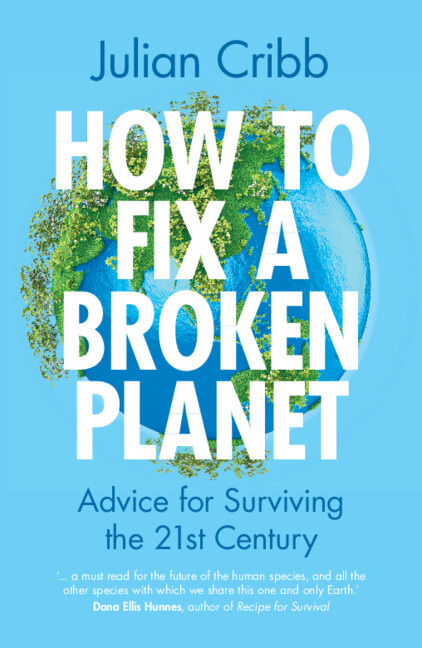
Reviewing "How to Fix a Broken Planet" by Julian Cribb

“How to Fix a Broken Planet” [lays] out very specific pathways and even ideas for how they will be paid for. These are truly well-thought out solutions and agreement proposals - the kinds of things that you wish would emerge from the COP sessions but never do - or that are announced and signed with much fanfare and then largely ignored.
Once upon a time, a group of house mice faced a terrible dilemma. A new cat had moved in and was systematically killing them off. The mouse colony held meetings and came up with dozens of different strategies, many of which were tried but their numbers continued to drop. One day a very clever mouse announced that he had come up with a solution. The other mice gathered round, as he gave his analysis of the crisis. “We know that the cat is bigger, stronger, and faster than us”, he said. “But we are smaller and able to more quickly change direction. The real problem is that the cat is absolutely silent, so we are always caught unawares.” The other mice nodded thoughtfully. “Yesterday, the family were taking down their Christmas tree”, continued the smart mouse, “and this little jingle bell, attached to a bit of ribbon, happened to fall off one of the ornaments. I found it behind a chair last night and very carefully brought it back here. I propose that this piece of ribbon be used to attach the bell to the cat’s collar. Once that’s done, it will be nearly impossible for the cat to stalk us without our hearing its approach and being given time to escape.” The whole colony cheered for the clever mouse. “At last! Our lives are saved!” There was much joy and patting on backs, until a small mouse stuck up her paw and cleared her throat. “Excuse me…”, she said, “pardon me. I, um, I have a question.” The other mice paused to look at her. “So, uh, my question is… who will bell the cat?”
This is a classic dilemma amongst climate and polycrisis activists. Indeed, a major source of frustration is that we are often reminded that ‘easy’ solutions to our global challenges have been well known for many decades, if not longer. The terrible effects of ecological overshoot are becoming more and more apparent. So why are we not doing more to avert certain disaster?
I have the privilege of chairing the board of a respected organization (the Canadian Association for the Club of Rome, or CACOR) which has grappled with these questions for over 50 years. One of its most valued contributions to the global debates is weekly virtual presentations from world experts who share their ideas and then discuss them with members. (All of these presentations are available here and on their YouTube channel - I highly recommend them.)
One of those experts is Julian Cribb, who has presented more than one session to CACOR and is also popular on Substack. In 2023, he published “How to Fix a Broken Planet”, which is a foundational document of the Council for the Human Future. This very fine work is worthy of a review, so here goes.
Julian’s signature starting place is that there are at least ten major imminent threats to human survival on this planet. Addressing just one - even one as important as climate change - while ignoring the others is not going to save the human race. As he puts it:
“There is no point in adopting measures to fix one disaster if, by so doing, we spawn disasters even greater, or more certain. Each action must first be examined in terms of every other major threat before it is adopted. It must make none of them worse.”
This is no easy feat, given the diversity of the crises that he lists:
Major extinction of species
Ecosystem collapse
Nuclear war
Climate change
Toxic chemical poisoning
Food supply collapse
Pandemics
Out of control technology
Human overpopulation
Insidious misinformation
There are now many books and science papers out there which detail the nature of these disasters, backed by overwhelming (and often terrifying) evidence. “How to Fix a Broken Planet” does an excellent job of authoritatively and accessibly summarizing that information and presenting it to a wide audience. It is a great reference for having the latest (2023) facts and background on all ten threats gathered together in one place.
However, as promised by its title, this is not primarily an awareness piece. Julian Cribb is focused on solutions and actions, and those are the major thrust of this how-to book. Each chapter addresses a different threat, and is divided into three sections: “The Problem”, “The Solutions”, and “What You Can Do”. I attempted my own version of this approach in “Our Second Chance” (2022). The major difference is that I was addressing the value philosophies underlying our metacrisis. Cribb takes a more practical/regulatory United Nations style approach to the solutions he has gathered together. Indeed, the overarching implementation tool that he proposes is called “The Earth System Treaty” - an agreement to be adopted by humanity as a whole, committing everyone to taking positive and meaningful actions.
In many ways, this approach is similar to the UN Sustainable Development Goals or the Earth4All project from CACOR’s international umbrella parent, The Club of Rome. A key enhancement on those works is that Julian has worked hard to cross-check each solution against the other threats, and is also proposing a mechanism for actually implementing and funding those solutions. (And for those who feel motivated to act right away, there is of course the handy “What You Can Do” sections, specifically geared to the readers themselves.)
I could attempt a review of the major solutions, but that might be somewhat disingenuous. I have no specific expertise in these specific disciplines, and I know that the content presented came from several better-informed collaborative sources. What I can say is that when Julian and other solution-mongers appear in our weekly “CACOR Live” sessions, we invariably get the question from the audience (often from the ever-popular Bill Rees himself): “HOW?” How do we make this happen? Who is going to do this? In essence: Who will bell the cat?
Again, “How to Fix a Broken Planet” attempts to address this very question by laying out very specific pathways and even ideas for how they will be paid for. These are truly well-thought out solutions and agreement proposals - the kinds of things that you wish would emerge from the COP sessions but never do - or that are announced and signed with much fanfare and then largely ignored.
And THAT’s the crux of my trouble with this work.
We are now at COP30(? - I’ve lost count) and nothing substantial has happened. Why? I have a separate post that explores this question in detail, within my framework of the Value Crisis, but let’s just review some basics. Consider this statement, right out of chapter 1:
“The first thing is for each of us, as individuals, to understand that our own personal future is at risk.”
If only! The sad reality is that a significant proportion of his readers in the environmentally-problematic wealthy nations are still what I call NIMPLEs - Not In My Personal Life Expectancy. True, that cohort is fading with each passing year, but the reality is that the more money you have, the longer you have pretty good protection from at least eight of the ten threats - and our leaders and decision-makers have lots of money! “Well yes, the hoi polloi will experience some floods, power outages, wildfires, AI job losses, and food insecurity, but I see very little of that in my neighbourhood.”
The second factor is even more dramatic. It’s a reality check which might be called ‘The Paradox of the Disappearing Majority’. Ask any typical population if they want to see immediate action on existential threats against humanity, and I’ll bet at least 75% or more will be emphatically in support. And yet (in Canada, for example) there are Green Parties (both federally and multi-provincially) who focus on precisely this sort of action. How many Green Party governments exist in Canada? Zero. (One can usually count the elected Green Party representatives on one hand and still order two beers from a distant server.) “Solve climate change and ecosystem collapse? Yes, please! Alter my lifestyle? Not a chance. More is Always Better.” This is where the Earth System Treaty faces a serious Utopian gap.
Don’t get me wrong. I applaud the work that Julian and his Council have done, and I highly recommend the book. The individual action lists are excellent, and I do honestly believe that the global action plan he presented could work - if and when the world is ready for it. Moreover, I hope that I (and/or CACOR) might be able to contribute in some meaningful way to the Council for the Human Future. His straightforward list approach and thoughtful considerations about solution-interplay could serve as an excellent framework for important conversations, allowing individuals and groups to move past the divergent thinking and get straight to the convergent action planning.
More importantly for me though, what this book inspired in me is a brand new concept which I’m tentatively calling the Status Quo Disruption Score.
The Status Quo Disruption Score
The concept is simple. For any major solution proposed to a global crisis, the following questions must be posed, scored, and totaled to ascertain the likelihood of adoption and success against the powers of the status quo:
How many jobs will be immediately eliminated? Across much of today’s world, unemployment is a more immediate survival threat.
What will be the scale of mega-corporation disruption? Let’s not kid ourselves. These legal persons run the planet, and we programmed them to pursue one thing only - a goal that they don’t fancy being messed with.
What will be the immediate impacts on current lifestyle success measures? Our personal concept of wealth is deeply ingrained. Consider my value change conundrum.
What deeply ingrained cultural practices might be threatened? Certain populations have a history of ‘ranking’ which cultures are more important, and the populations being ranked downwards are not very supportive.
What inter-nation power shifts are likely? Will the solution involve one country gaining status and another losing it? That typically does not go over well.
To be effective, how much does this solution rely on a dramatic change of information being consistently presented to the masses? The challenge of clear and consistent communication is the precise problem right now. How will that be solved?
What channels will be used to convey and promote the new ideas, values, and behaviours? Many of the proposed solutions involve ‘simply telling people the truth and how to fix things’. Unfortunately all of the channels for that kind of communication and education are deeply under corporate control and/or subject to the misinformation crisis that is already a listed threat.
How will the long-term investments and plans of the private sector be affected? Businesses and people all exhibit investor value personae that make plans and sacrifices now, based on the predicted future rewards. A vastly altered future puts all of those at risk in a way that is much more familiar (and thus, worrying) than novel unexperienced threats.
Who takes ultimate charge of redefining acceptable behaviours, specifying regulations, and enforcing them? Cribb suggests that the arbitrators be independent scientists and experts. Selected by whom?
Do the proposed changes have to be universally implemented in order to be effective and not powerfully deleterious to the adopters? This is another way of framing my value change conundrum. If being an early adopter puts you at a huge disadvantage within the remaining status quo, who will jump first? If everyone has to jump together, that’s a pretty tough leap to orchestrate.
THESE, I suggest, are the biggest questions to answer satisfactorily before one can even begin to implement many of the sweeping reforms called for in Julian Cribb’s book. In short, I believe even earlier steps are being inadequately addressed.
(I’ve fallen for this trap myself. Anyone who brings up the examples of changes made to fight World War II or COVID-19 as precedents of what is possible should carefully note how the the above questions were addressed as we took action for those global events.)
The status quo has to change first.
One way of doing this is to experience some sort of partial (or total?!) civilizational collapse first. I know from conversations that Julian has not ruled this out, but collapse only appears in the book as something to be avoided - not a possible prerequisite to our existential survival.
I’m running the risk of being classified in these circles as a ‘doomer’. An earlier post suggests that before applying that label, context is everything. For example, I remain convinced that a Universal Basic Income (UBI) (what I prefer to call a Guaranteed Living Allowance) could be the beginning of the required value paradigm shift. What excites me the most is that a UBI scores very well on the Status Quo Disruption survey. It might even alter our value systems enough that we could implement an Earth Systems Treaty! Evolving our way out of our predicament is not impossible.
As all mice know, when it comes to preserving your species, having a plan and being able to acquire the necessary equipment are essential. However, if the predator threat is still 100% operational, someone may first have to convince the cat to wear the bell.

Many thanks for a most useful commentary, Andrew. I wish it to be clear that the 'solutions' described in 'How to Fix a Broken Planet' are not my own, but those of the many scientists and experts who have studied the building catastrophe in our future. My contribution has been to try to integrate them so as not to cause worse harm to come to us. In all cases I encourage readers to work on their own solutions.
My only request is that we not to dally too long arguing over the 'status quo' items, or the collapse of civilisation and our own possible extinction become inevitable. Keep focus on what has to be done to save ourselves - and forget about rearranging the Titanic's deckchairs!
Two comments.
One, I think it’s too late for solutions. The world has embraced right-wing authoritarianism and fascism at this point. We are moving in the direction opposite solutions and will continue to until collapse. I find books like these to be “false hope for profits”.
Two: in the list of ten things, overpopulation doesn’t appear until #9, when that, which is why we have overshoot, is the only actual “problem” that we have. The other 9 problems are all symptoms of overpopulation.